Friday, October 16, 2015
Crete is Greece, right?
A little over a year ago I went to Crete. It was wonderful.I didn't go alone, I was in love. I would take the same trip again in a New York minute.
In that last year I haven't written much and that is my fault. Also, during this trip to Greece I didn't take many photos and didn't mind one bit. We all make sacrifices for love.
I discovered a lot of interesting things on this trip. One of those things is the "all-inclusive holiday" that the British just can't seem to get enough of.
Most people who know me know that I am not particularly a fan of the English, I blame my Scottish heritage and my American revolutionary sensibilities and the fact that they whine about everything. I do have some British friends who I really like though. What the English do on their all-inclusive holidays makes them even more intolerable. These vacations are offered at amazing prices. Everything is included; airfare, hotel, transportation, three meals a day and for a little more an unlimited supply of alcohol. The English want to get their money's worth. This mentality causes them to wake up, eat breakfast and start drinking as soon as possible. They continue to drink well into the night. The only thing worse than an Englishman is a drunken Englishman. That being said, I don't want this to be overly negative because the trip was amazing. I will stop complaining about the English.
We (I will also not pretend for the rest of this entry that I was by myself because that isn't fair) booked one of these all-inclusive holidays and the price was impressive. We didn't spring for unlimited booze though.
Our hotel was basically designed specifically for romantic getaways and if anyone reading this is looking for ideas put the Elounda Blue Bay Hotel high up on your list. They don't allow guests under the age of 16 there so it was a bunch of adults having a great time in a secluded bay on Crete. Seriously, there aren't a lot of better things. For me staying on a sailboat in the bay would have been more perfect, but not everyone likes that kind of thing.
I have also heard that there is a sea urchin problem at Cretan beaches. I did even see a few signs on other parts of the island advertising particular resorts with beaches free of the spiky little bastards. The Elounda bay was completely devoid of these guys.

Above is the view from our hotel. A panoramic view of course. As you can see the hotel rooms are a little more like bungalows and some of them even have private swimming pools. The small island at the mouth of the bay on the left is man-made and at one time had a fort, built by the Ventians I think, to protect the bay from intruders. There are ferries going out to it all day long. Waking up to this view every morning was refreshing.
The hotel is near a town called Elounda. It's a relaxed little town right next to the water. I learned that Greeks, or Cretans, are very relaxed people. The village was hopping well into the night and everyone was out and about enjoying the evening. It didn't seem like people really started to go out and have a good time until 9 p.m.

We would walk to Elounda almost every night and just walk through the town. It was less than a mile from the hotel and made for a good evening stroll. Like I said people were always up and doing things and everyone seemed to be pretty happy. Also, they have grocery stores and whatnot, so if you require some provisions it's the closest place to go.

Fishing appeared to still be a viable way for people to make a living and there were dozens of these cool-looking little fishing boats. They look much like the ones I saw in Bulgaria, just with a little better upkeep.

The water was very clear right up next to the shore and I was always amazed when we passed this little boat that appeared to be flying rather than floating. I looked like this during the day too, but we were always busy during the day, and I only took my camera with us to Elounda once and I had to take this photo even though it is really noisy.
We rented a car from some local place in Elounda and that was an interesting experience. We walked into town and went into a rental agency. It was about 8:30 at night, these places close at 10 p.m. which was strange. After telling the agent, who I think was about 16, we wanted a car and picking out a little economy number, Peugeot 106 I think, we gave the guy a 20 Euro cash deposit in exchange for a hand written receipt and left with the understanding that the car would be delivered to the hotel in two days.
Surprisingly, right on schedule, the car was delivered to the hotel as promised. I filled out a more official-looking form and the kid who rented us the car sped away on his scooter. Scooters are everywhere on Crete and people use them to travel long distances.
We drove to Heraklion and took a quick look around.

It's pretty much what you would expect except more crowded. Buildings stacked right on top of each other and everyone cramming everything into every space possible. I guess when you live in a place for a few thousand years urban sprawl isn't really a thing.
There were ancient fountains, like you see above, and cafes everywhere. Each cafe had it's own table with two old Greek dudes hanging out and debating life or politics or cheese, I don't know it was all Greek to me.

This particular cafe had debating old guys and rosary old guy, pretty cool right? At least I think it is called a rosary, I'm also not particularly well versed in my Greek Orthodox traditions. So we had some real frappes and relaxed after a stressful drive into down. I'm told frappes are a Greek invention. They are good, but not like what you'll find at Starbucks.
Driving on Crete, and because I like to apply limited experience to an entire country Greece, can best be described as an adventure. The lane-marking lines and dashes are mostly a suggestion. Seriously, I saw people straddling lines for miles. It's perfectly fine to straddle the line and pass between cars next to each other in two lanes, just normal, it's how they roll. Driving on the shoulder, or as my mom always used to call it "the emergency lane" is completely normal, especially if you have an underpowered scooter or car. You might come around a corner and see that someone it 50-75% in your lane speeding and you just have to deal with it. And passing on the right, my second-biggest driving pet peeve, is a very common occurrence.

Heraklion also has an ancient harbor that is still in use today. You can walk along its walls and it's interesting to see how this old harbor was built and still functions. There are a few locals selling sponges and things for inflated prices. Near one end of the harbor there is also an old fortification of some sort. It's at the end of a jetty built to basically made to form one side of the harbor. The fort is being renovated but might provide and interesting tourist attraction when it's finished. The water in the harbor was not as clear as the water in Elounda, as you can see from the photo above.
From Heraklion we visited the ruins of Knossos. I honestly don't remember that much about it, because it's been over a year, but I really enjoyed seeing it all.

The photo above might be the most recognizable feature of the city. It's the north entrance and has, of course, been restored.

This is one of the roads that lead into the city. Of all the truly impressive archeological things to see at Knossos, I think I liked the road the best. Look at it, it's immaculate and very beautifully constructed. It might also be restored. Lot's of things at Knossos were.

I think this is some kind of throne room or something. While it was very hot at Knossos these chambers were very cool and comfortable. For me it was interesting to see how some of the city had been restored and some of it had just been excavated and left alone.

This storage silo area was also interesting for me. I don't know why. Maybe I like strange things, which I won't argue against. I just think it's very complicated to lower, and then retrieve those enormous grain pots from a hole in the ground. I understand in the climate it was most likely the only way to preserve the grain. They didn't remove the pots, called "pithoi" when they were full, they would just dip into them.

Some of the pots were replicas. I don't remember very well, but I think the ones in the photo above are actually very-well preserved original pots. I can't be certain. I do know for a fact that some of the pithoi we saw were infact original.
After a few hours at Knossos we decided it was time to head back to Elounda. We were pretty far away at this point, but didn't foresee it taking too long. In reality it took a long time and I wouldn't have had it any other way. Being in love and cruising through the center of Crete on tiny romantic roads stopping on a whim to look at a monastery or church on a hill is one of the best ways to spend an afternoon that I can think of.
Not too far from Knossos there was an actual, real, unrestored ruin. We saw a tiny sign for it and went to check it out and have a picnic under a tree once we saw the view.

The ruins were really just over-grown stone walls, much like what you would find in the American Southwest. The view was the most impressive part. There were olive and fruit orchards as far as the eve could see and a gentle hilltop breeze made the shade a comfortable and relaxing place to sit and just look at this view while we ate.
After lunch we continued though the interior of the island and I seriously can not tell you the exact route we took but we went though the Dikti Mountains and the views were also amazing. We also drove tough a funeral in a tiny village. It was a bit of an oops moment. Fortunately, we didn't add another body to the procession. The roads were so small though that I was just waiting to come around a corner and land in the middle of a heard of goats or something.
There were a few other places we wanted to try and see, but once we realized that we were so far off track that we were not going to get to them we just bombed around and enjoyed it.

We stopped in this little village for some more frappes. They were good and the cafe had a contingent of men heavily engaged in backgammon. Now of course I haven't been to Italy yet, but I really have to say when it comes to just chilling out the Cretans have some serious skills.

I took photos with my phone in all the little places where we stopped so I would have some geotags, but honestly I'm being lazy. From this village we ended up visiting a little church on one of the nearby mountain peaks.

Olive fields cover much of the mountains and we were on the island at the beginning of the harvest season. When it wasn't olives it was grapes. It was nice to see the grape boxes stacked at the end of endless rows of vines. I've harvested a few grapes, it's not easy work and I only tried it for like 30 minutes. Realistically, coming around a corner and hitting a sheep shouldn't have been my biggest fear. Meeting a truck full of grapes should have been, but we're still alive so everything worked out fine.

There were orthodox churches everywhere and most of them were in quite excellent shape. They all looked almost new or perfectly maintained. I think I know where all those EU loans are going. The one above was in a little village in a valley and the local population must have been pretty busy harvesting olives or something, because there was nobody out.

This monastery looks brand new, doesn't it? It was perhaps so new there weren't even any monks yet. I am kidding of course. We didn't see anyone, but this is a very old monastery. I seriously think everyone was working on harvesting grapes, or chilling someplace cool but the temperature was much more comfortable high up in the mountains. At some points it was even a touch chilly.

Above is the dinner bell for the monastery. It's the only thing there that you can easily see that says "old." That is one old piece of iron.
There you have it. I honestly think I will go back to Crete someday. I will spend a bit more time exploring the mountains and little villages or hamlets or whatever. The island really has everything I like, sea and mountains. I became very envious of a particular sailor who had anchored his boat maybe 150 yards from the shores of Elounda. The sea floor drops off steeply in the bay and you can cosy up to the shores easily even if your boat has a deep draft. I still have this dream in that whoever was on that sloop would wake up in the morning, eat breakfast toss his clothing for the day in a watertight bag and hop over the gunwales and swim into town.
Wednesday, September 16, 2015
Sofia, Bulgaria Round Two
I have so many photos from Bulgaria that I decided to make a third, and final, post. I shot about 800 photos in the two weeks I was there. I realize that this is a relatively small number and as someone who used to crack over 150,000 frames a year, 800 in ten days is child's play. All that aside, I like to think I'm a touch more choosy when it comes to shots. Of course I'll be the first to admit that my skills are lacking a bit since I don't shoot every day anymore. Whatever, I still love it.
I think for me the most striking thing about Bulgaria, and really Sofia in particular, is the combination of two worlds. On the one had you have this old-world Eastern European, post-soviet microcosm and on the other hand you have a society that is trying to modernize and get out of the shit. It's happening slowly and when the two meet, which is often, like when hot and cold air meet -- you get a tornado, of conflict and confusion.
I'll begin with the Sofia metro. It is beautiful. As beautiful as a metro system can be I suppose. It goes to places people actually want to go, like the airport. It gets closer to the terminal than the Washington D.C. metro gets to Reagan airport. One station is like a grand boulevard underground with streetlights and benches where people can sit (boldfaced so maybe someone in Prague notices, there are maybe 5 benches in the entire Prague metro system). But then the metro train arrives from 1972 Moscow and you are left thinking, "what is going on here? They sprung for a whole metro but couldn't buy a stupid train?"

See, look at that station. It is an architectural and design masterpiece, probably and engineering one too but no one cares about engineers. Then look at the train. It looks pretty nice, you might be saying right now. I urge you to scroll on back to my post about Budapest. The train you are looking at here is the exact same type of train that runs on the blue line in Budapest. You'll not see this angle from the blue line in Budapest though because those stations are mine shafts compared to this exquisite underground gallery of a metro station. And if you don't believe me that this is a soviet metro train have a look here:

Now, my Russian is a bit rusty, if by "rusty" you'll accept non-existant, but down at the bottom it says "Made in USSR." That's a translation of course. To be fair, these metro cars are expertly restored. And when I say "restored" I mean it, they hardly modernized anything. What they did do was replace nearly everything with new parts.

Once again I will point you back to my Budapest post. Look at the inside of the metro car there. The one from the blue line is the exact same model as this one. Tell me which one you think looks better. Also, Sofia did buy some modern metro trains and they are very nice. On the flip side, I have since returned to Budapest and they have a whole new metro line with new trains too.
The fiercest tornados are the ones that occur when buildings are involved, aren't they all. There are places where you basically end up with the architectural equivalent of an F5, but we'll ease into that.

This scene isn't so bad, but none of the styles of these building match. Here it's quaint (I hate that word) and maybe even a touch romantic. At least they are close to the same colors.

Above is a little bit more extreme example of the lack of architectural continuity. None of these buildings is the same. To be honest, it looks horrible. No one even bothered to look at the buildings around what he was going to be building. Someone just said, "yup there is a building on the right, that's cool I'm still going to do my own thing." So, in essence, modern Sofia's look has been created by angsty teenagers.

Then you get situations like what you see above. This might actually be an engineering masterpiece. How this modern, glass, multi-story building was able to be constructed and connected with this complete piece-of-crap clapboard shack next door without it being knocked over is beyond me. It happened though and this is not the only example in the city. It's kind of fun to walk around and be amazed at how certain things were able to be built without destroying the neighboring structures.
I think much of this inconsistency comes from the vast history of the city. Like I said in the last post, it's possible to see nearly 7000 years of history stretched out in front of you at several places in the center. A good example is at the Cathedral of St. Joseph which is a relatively new building. It's not the biggest cathedral in the world, but it is very modern and cool.

I spent some time in the cathedral courtyard as I was a little tired and there was nobody there. I mean nobody, it was a quiet, shady respite for me for about 30 minutes. I decided to study the building a little bit and the broom and bucket were interesting to me, so I made some frames. I like all the lines.

Behind the cathedral are more ruins. I am not sure if they are ruins of the original church that was there. It's hard to tell. The original church was bombed by the allies during WWII, probably by accident because carpet bombing isn't the most accurate. Sofia was bombed a few times after the Bulgarians decided that maybe the Germans weren't really bad dudes and joined the Axis powers.
In the photo below you can see the ruins I'm talking about as well as a few buildings that don't really match and the back of the statue of St. Sofia, who the city is named after. She's on the right in the middle. It's a little difficult to get a good photo of her from the other side and I didn't want to work too hard to do it.

If you go to Sofia I highly recommend visiting the National Archaeology Museum. It is well worth the price of admission, which is something like €10. They also have a really cool bar out back and it's perfectly located in the center of the city. I could probably make even another post about the museum. I'll just say that they have lots of neat stuff and Thracian artifacts. I always thought the Thracians were just some mythical tribe some TV writers dug up, but they were a moderate civilization. This bronze bust of Apollo is there, it's from 2nd century Serdica, which was the capital of Thrace, it basically came from within one kilometer or where it sits today.

Another worthwhile place to visit is the Church of St. Sofia. I could also do a post on the tomb under the church with funeral vaults from the 4th century. Like these funeral vaults below. You can see the inside of the church through the window in the crypt ceiling.

For some reason I like to take photographs in graveyards. I don't know why they are fascinating to me, but they are. I felt that I needed to go see Sofia's cemetery. It is huge. The most striking thing about it to me though is that the entire place smelled of incense. I don't really understand why, but it did. The graves aren't very well maintained, which is what I was hoping for, but the place wasn't particularly scenic either.

As you can see the maintenance isn't what I'd call spectacular. I think families are mostly responsible for maintaining these places and as generations pass people stop caring about the graves of their ancestors. It's a shame for this to happen, but I understand it. Perpetual-care cemeteries are normal in the U.S. but I expect they are quite expensive. Europe also has a much longer history of people dying, so there are laws and provisions in many places for how you remove remains from your family plot to make space for new dead people. It's interesting. There are also ossuaries, which I don't think we have in the U.S.

Benches and such are really quite normal in cemeteries. I just liked the way this one was situated.
What I found interesting was the organization of cremated remains. The structures you see below mimic the thrown-together style of the city center in a way. There were other structures that were better constructed and organized almost exactly like communist blocks of flats, or apartment complexes to us Americans.

Then there is this thing where the family puts up what I can only assume is a paper headstone. I've seen this in Prague too, but it always looked like it was a temporary solution while a more suitable and permanent headstone was being created. I don't know for sure. Seeing this tree with paper headstones pinned to it was pretty fascinating to me. It definitely appeared to be for more than just temporary use.

As I was leaving the graveyard, I decided to make my way to the bathroom. It was a long trip to the cemetery and I didn't want to have to deal with any police if an urgent need to micturate struck me while walking back to the center. That is when I really realized I was in far Eastern Europe because I saw this:

Now, this isn't the first toilet photo I've posted in my blog. I was pretty awestruck when I saw this. The farther east I traveled in Bulgaria the more of these I started to see. I'll leave everything else about this device up to you to answer with your imagination. Even if you don't read Cyrillic at all, it's not hard to figure out where the bathrooms are though, thank God.

Sofia also has a few outdoor markets. They are generally busy. They even have a market solely for books, I didn't look to hard at it but I didn't see any books in English. I'm sure someone somewhere at the book market had a few classic English tomes though. I wandered through the biggest outdoor produce market. I honestly don't know it's name, but I know a few Sofians I can ask. If I find out, I'll make an update. While I was talking to some Sofians about my trip to this market they told me that the best scad in town are to be found at a stand in this market. If you're brave you can try scad, it's basically a small fish fried whole. You get a plate of 5 or 6 and chow down. I had them in Burgas, they are tasty.
Anyway, I digress from scad back to the market. I wandered through and shot everything from the hip. It shows, but the great light and subject matter made for some decent frames.

You could buy a lot of things at the market besides produce. I saw a guy selling used light bulbs. At least I assume they were used, they certainly didn't appear to be new. This guy had about a thousand different kinds of honey. I saw a few stores just for honey throughout Sofia.

The great thing about this market is that it was actually crowded. Now, I really don't like crowds and try to avoid them if I can, but this was different. I also stayed alert and kept my hands on my stuff to make sure I kept it all. I would do the same thing at a crowded market in Prague or Barcelona too.

And what outdoor produce market would be complete without the potato man? Certainly not an Irish one, that is for sure. The potato man was well lit too, and he was one of the last stands in the market.

From the potato man's stand it is a very short walk to the Lions Bridge. As you look at this photo of the bridge you can see a few things, one of them is the majestic, raging Vladaya River. It's the broad, romantic river that runs through the city. I'm kidding, it's four feet wide and I swear I saw poop floating in it. This bridge it totally overkill for this river, even in pretty good flood stage.
The Lions Bridge is named for the four bronze lion statues on it and was built by a Czech architect. I think there is some other cool history about it, but I'm not sure. But you can see the older-than-the-metro-train trams crossing the bridge in this photo.

Below is another photo of the super-old trams. Trust me, traveling by tram in Sofia isn't really for people who don't know where they are going. There are no announcements as to which stop you are approaching or what the next stop is. It's actually positively intimidating if you don't read Cyrillic. I had to look at the tram map at the stop I was at, then use a mapping app to get the name of the place I wanted to go and think of it like a picture, then find the picture on the schedule and count how many stops away I was. Then, once I got on the tram I had to count the stops carefully. If you know where you're going, you can just look out the window and you'll know when to get off.
Yes, Sofia has a few modern trams too, but they don't go anywhere a tourist would want to go. Also in the photo is another vegetable market. This market is a lot closer to the book market and there are a lot of rouge sellers who don't want to pay for a table all around it. Some of them looked to have really good stuff.

So that's it. I promise no more posts about Bulgaria for a while. I'll wrap up by saying it was a wonderful place to visit. I think it's highly under rated. Of course I didn't see any mobsters or crazy violence like I've heard about, but I did see gypsies and stray dogs, so I think it all worked out.
Tuesday, September 1, 2015
Burgas
In my last post I talked about my trip to Bulgaria, mainly Sofia. One of the other things I wanted to do was go to the Black Sea. It turned out, due to the planning of my trip, that I would be there on the Fourth of July. Had you told me 10 or even 15 years ago that I would one day spend the Fourth of July on the Black Sea I would have told you that you were a liar.
The Black Sea isn't really a place many Americans think about, even fewer visit. As an experienced American, I think I am qualified to make this statement.
I didn't want to go to a super-touristy town. Which ruled out a few Black Sea resorts like the area know as "Golden Sands." I chose a city called Burgas. I was happy I did.
While Burgas may not be the most picturesque or romantic looking town in the world it is still beautiful and relaxing to see. It isn't very "old world" because there is a working port there and it is one of the largest cities in Bulgaria. As a friend of mine put it, "It's a city, people work there."
The idea of something like this was attractive to me. I didn't really want to try and spend five days roaming around streets. I wanted to chill on a beach and contemplate the deeper meaning of Fresh Price lyrics and other important philosophical pursuits. I was also thoroughly disinterested in trying to navigate a resort crowded with British tourists who had purchased all-inclusive vacations. The all-inclusive holiday allows you to pay for all your alcohol in advance. Brits love this and feel the need to get their money's worth, therefore they spend their holiday virtually immobilized on a beach somewhere drinking themselves into comas from what they consider their entitled, unlimited, free-flowing booze fountain. I didn't want any part of that.
The beach at Burgas is essentially a city beach and the city did something very smart in the late 1800s. They built the Sea Garden. Technically it was officially started in 1905, but read the wiki and find out more. This park is about 500 meters wide and several kilometers long and it separates the city from the beach. This brilliant idea makes it impossible, for now, for anyone to build a resort hotel on the beach. Just this greatly reduces the number of tourists. I applaud Burgas for it.
 Above you can see the Burgas pier. It's not the most amazing pier in the world, but it does the job and it has a cool observation deck on the right side. There isn't a ton of stuff to see from it; there is a distant lighthouse and you can see the port but that is about it. You'll notice from the photo that there is an oil-drilling platform in the distance and a tanker. Like I said, it's a working town, so what would you expect. Under the pier there were lots of jellyfish.
They are harmless, but still no one wants to get stung by a jellyfish. This made the most popular activity on the pier even more crazy. Local kids were jumping off the far end. Some of them even jumped from the observation deck.

As you can see there was is an ad hoc diving platform for the kids to jump from. There were kids jumping from the pier a little closer to the beach too. I don't think this was particularly legal, but the police made a trip out to the end of the pier, spoke with the kids who all walked back to the beach. About 30 minutes later a parade of kids headed back out to the end of the pier. You should be able to see kids jumping off the pier closer to the beach in the first photo.
I was in Burgas to lie on the beach and didn't take too many photos. I did however, take a trip to the local resort town of Sozopol to see what it was about. I took more photos there.
There is an old town and a new town in Sozopol. The new town is a tourist/resort place. I didn't like it. There were arcades and a big boardwalk and it was not appealing to me. Old town Sozopol was a different story.
Much of old town Sozopol is built on the top of the sea wall. The town is on a small point into the Black Sea. The views are cool, but there isn't much room for sandy beaches since there are so many cliff-like formations.

You can see a little bit about how the old town is from the photo above. There is an interesting mix of old and new buildings in the town too. For example there were what I assumed to be hotel rooms opening onto a path of the top of the cliffs, next to some shack that maybe someone was living in. I'm not positive, but there was laundry drying on the line in front of it.
 Like I said there were many rocky and cliffy beaches around this part of the town. It made it an easy to defend position and there was a sign stuck on an old gate explaining that this part of the town was once a fortification. There was also a sea gull on a rock that I just had to take a photo of. I'm not really a wildlife photographer, but this one is not bad. Cameron Carver can tell me if it's any good or not.
Buildings were made of brick and stone too. Those buildings looked to be newer than the old stone ones.

As you can see, there is a mix of wood and stone. I don't know why these houses are like this, but I'm also not an architect.

These houses look a little more modern. I think one of the oldest in tact building I saw was the Church of the Assumption of Mary from the fifteenth century.

From the street it looks a bit short. This is not the case. It is simple and wooden inside and much more inviting than an orthodox church. There were some ruins of churches in Sozopol, like the rest of Bulgaria. I think this might have been the warmest church I went into during my trip. Warm in terms of welcoming; the temperature was pleasant.
I walked down Pelican street mainly because my grandmother had an incredible fondness for pelicans. She named her house Villa Pelican if that tells you anything.

There I found this quaint little chapel. The name escapes me at the moment. I'm fairly certain it is written on the side of the building, but I don't read Bulgarian so I can not be sure.

Further down Pelican was this exquisite example of soviet-era automotive manufacturing, the Lada 4x4. I saw many of these in Sofia. For a short time I thought I kept seeing the same one. Many of the ones I saw had the same paint, dents and other marks. It was truly awe inspiring to see a production run of cars where the paint all faded the exact same way on all cars. I'm not sure the one above has moved much in the last year or so, but it is difficult to tell with a Lada.
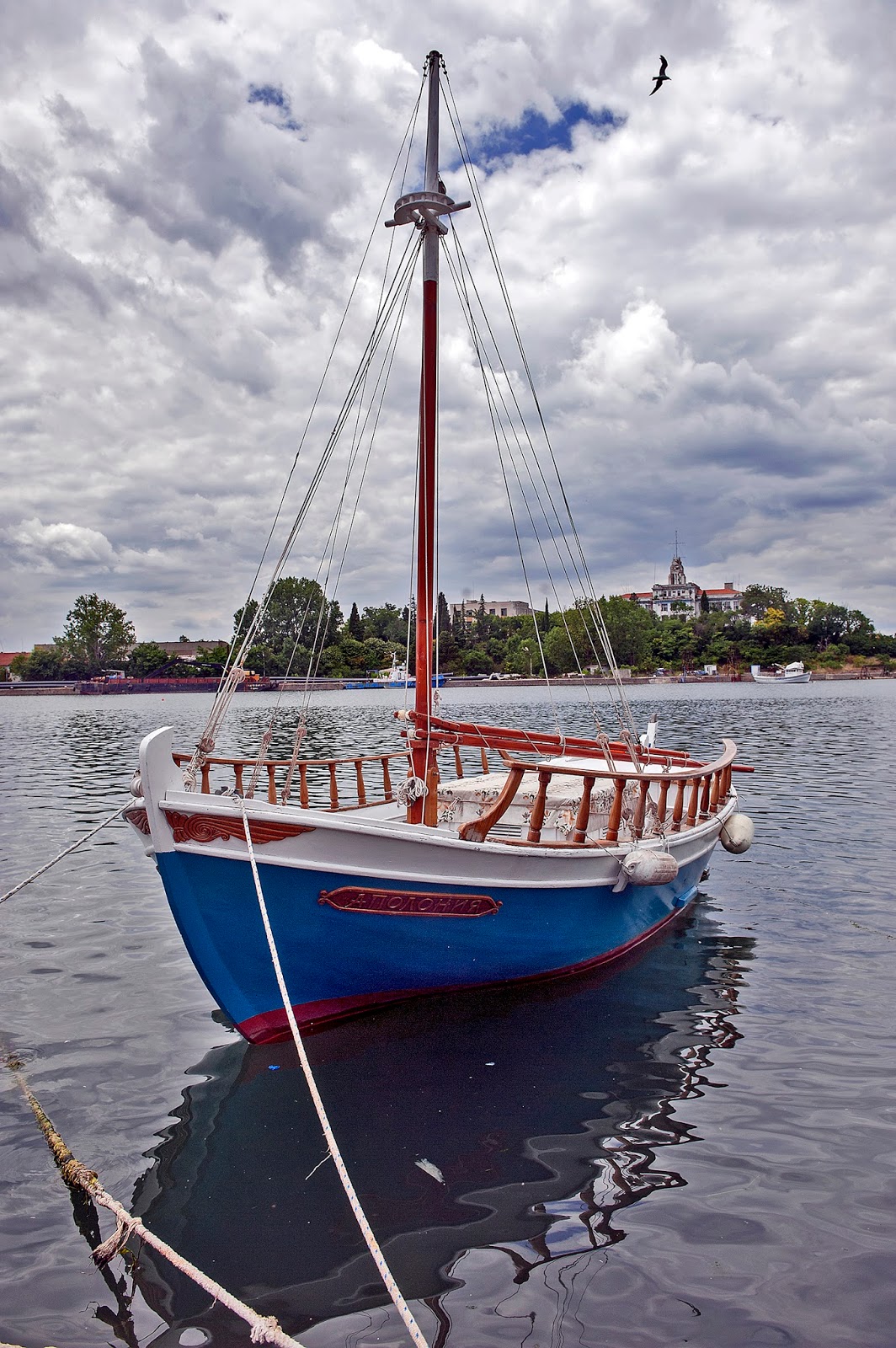
Wandering down Pelican St. eventually lead me to the sea and some docks. The boats here looked a lot like the ones I saw on Crete. I'll make a Crete blog post soon. There were even some boats being repaired and maintained.


Keeping with what I expect is a long tradition of being a city of mariners there is a museum near the sea wall cliffs. It was closed, but there were some old mooring points there. Rusty iron and old anchors always make for fun photography.


I'm not sure if the black and white treatment helped or hurt this photo. I stuck it in anyway.
Then there is the obligatory church ruin. I forget what this church was, but I think it was from the fourth century or so. Bulgaria has a lot of churches from the fourth century.

Then I was on the bus back to Burgas. The trip between Burgas and Sozopol takes about 30 minutes and costs 5 Levas each way. That is something like 2.5 Euros. It's sooooo cheap.


